motyl.dev Weekly #29: Week 38 (Sep 14 – Sep 20, 2026)
A curated digest of what I found worth reading this week.
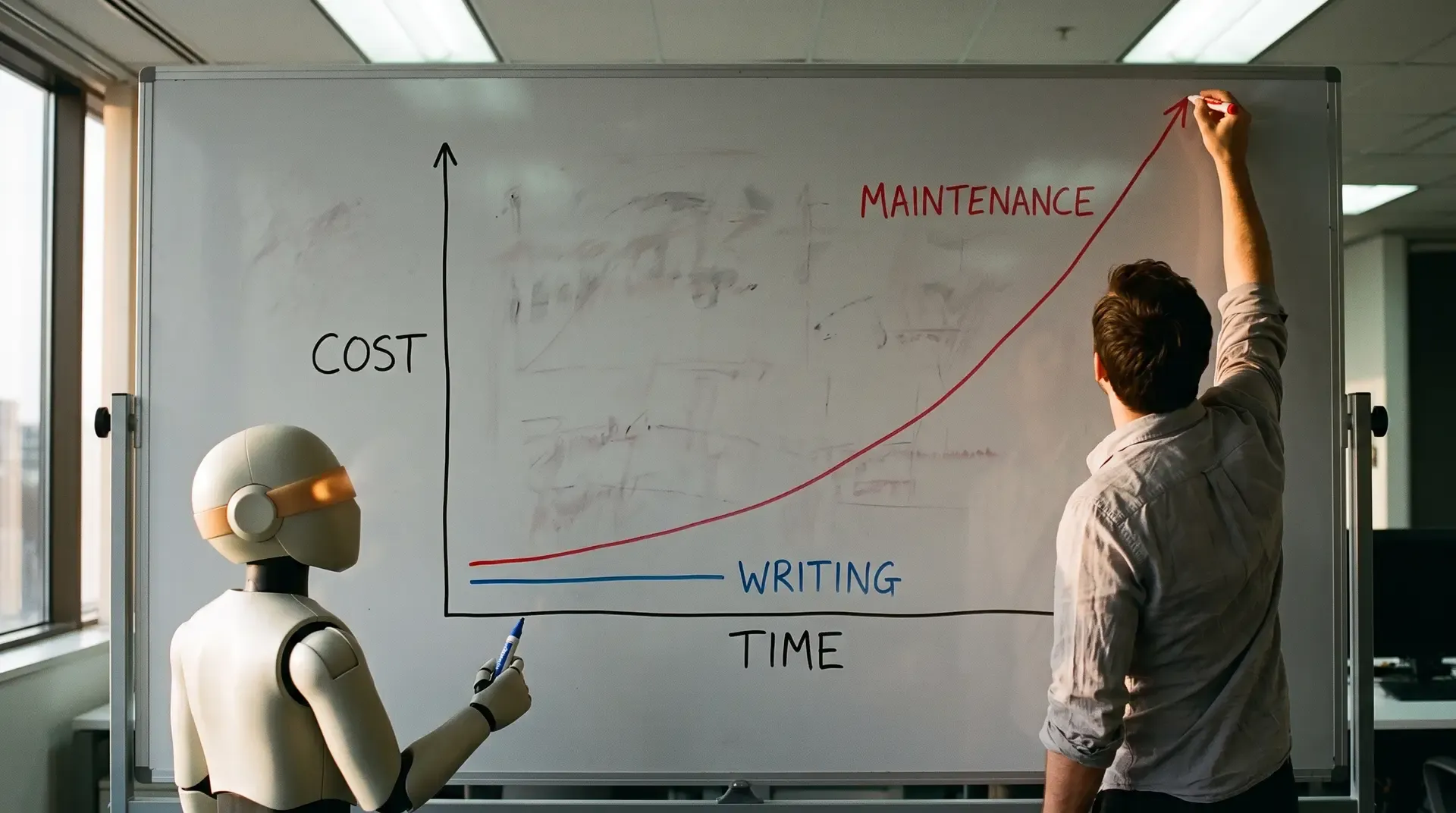
Twelve links this week and one argument running under most of them. Writing code is nearly free now, so every cost moved to the far side of it. The featured piece has the best name for this, the symmetry problem, and once you have the name it starts turning up in odd places. Three of the tools below compete on how few choices they leave a model, not on how fast they let it move. One release is a model that answers without generating any text at all. And an essay on borrowed trust ended up a few paragraphs from one on the quiet exhaustion of keeping up, which I did not plan and now think is the point. Writing got automated. Checking did not.
✨ Featured
We Were Promised Jetpacks: Why AI Isn't Accelerating Feature Delivery AI writes about half the code at Google and a third at Microsoft, and the delivery curve still refuses to bend. The author's framing is the cleanest I have read. Building and maintaining are opposite mental processes. Building runs forward from an intention and skips most edge cases on purpose, which is exactly the shape models are good at. Maintenance runs backwards from a failure and has to enumerate the edge cases you skipped. Stack Overflow asked more than 30,000 developers and 45% named debugging as a growing frustration with AI, for the boring reason that you are slower in code you did not write. Some studies put the net effect at 20% slower. I would not treat that number as settled, but the asymmetry under it is real and no better model fixes it.
🧾 Guardrails, or the lack of them
The Slop Should Not Be Tolerated
The loop is solved. Codex has /goal, Claude Code has /goal and /loop, and the agent will happily work, commit, repeat. Nobody solved who declares an iteration finished, because today that is the same model that did the work. The example that stuck with me is a covered line with an empty assertion, types silenced by one comment and the linter by another. Green, and worth nothing. SlopCodeBench ran fifteen agents across thirty-six tasks and 196 checkpoints, and in three cases out of four the code got more complex and more redundant with every iteration even when the agent was told to care about quality. Better models moved the starting point, not the slope.
Confidence is not transferable An agent implemented a complex code metric in 15 minutes and the author could not verify it for hours. When the same agent writes the implementation and the tests, passing tests prove the code agrees with itself, not that it agrees with the spec in your head. He calls it trust laundering. Probability goes in, apparent certainty comes out, and no independent evidence shows up anywhere in between. The uncomfortable part is generational. Years of writing code without an assistant buy you an instinct for when something smells wrong. Nobody starting this year gets to build that instinct the same way.
From a Raw Shell to a Sandboxed Coding Agent It opens with a Claude Code session inside the author's Obsidian vault firing a cleanup command that deleted half his notes, saved only by sync history. Then he reads the source of Claude Code, OpenCode and Pi and rebuilds the sandbox layer from scratch on Docker and Modal. The architectural call worth stealing is to not containerise the whole agent runner. Keep it local, run only the tools that touch the filesystem inside the box, and let the model emit a command while the runner decides where that command actually lands.
🧰 Written for the model, not the keyboard
A deep dive into StyleX
A thorough StyleX tutorial with a claim buried in the middle that I keep coming back to. Tailwind wins on short class names that are fast to type, and that advantage is aimed entirely at a human at a keyboard. If an agent writes most of your UI, the advantage is worth nothing, and StyleX's much smaller space of legal choices becomes the better trade. Styles only through stylex.create(), composition only through stylex.props(), shared values only through tokens, no selectors reaching across the tree. Linear moved off styled-components in more than a thousand pull requests, so it survives contact with a real codebase.
shadcn-ui/lint: An agent-first linter for Tailwind design systems tool
The premise is that a type error tells the agent what it cannot do and never what it should do instead. "padding does not exist on this type" does not help anyone centre a button. @shadcn/lint lets you write per-component contracts whose error messages name the actual fix, like use the size prop or put the margin on the parent. Across 150+ task runs on Sonnet 5, Haiku 4.5, Opus 5 and GPT 5.6, nearly every task hit zero violations after a single correction round, and fixing violations cost 10 to 48% less than describing the same rules in a prompt or AGENTS.md. Error messages turn out to be cheaper than instructions.
TSRX | TypeScript Language Extension for Declarative UI A JSX successor that compiles to React, Preact, Solid, Vue, Ripple and Octane, with control flow, scoped styles and statement containers as real syntax instead of things you smuggle through expression slots. The justification is the interesting half. They cite the Lost in the Middle research on how models handle long context and argue for colocation because related things should sit near each other. Setup first, one output node after. Language server, Prettier and ESLint plugins and a Zed extension already ship, JetBrains is in review. I am not convinced the ecosystem needs another superset, but at least this one is honest about who it optimises for.
claude-code/mods/agents-md
Claude Code now ships a plugin that reads AGENTS.md the way it reads CLAUDE.md. The default mode picks up AGENTS.md only when no CLAUDE.md exists anywhere in the tree, and switches itself off entirely if it finds one. There is a mode that loads both with de-duplication against @-imports, and a managed-only mode that throws away personal and project instruction files and keeps whatever the organisation pushed. That last one is what will matter inside companies. The key is instructionFiles under pluginConfigs, or Project instructions in /config.
🧱 Frameworks and the shape of the job
Do Frameworks Matter Anymore? The argument Lybrand takes apart is one you have heard. Models are best at React, frontend is mostly presentation, so pick React and stop thinking. He follows it to where it actually leads, which is raw Web Components or jQuery, both extremely well represented in training data. A framework is abstractions, structure and constraints, and his conclusion is that an agent denied one will build its own worse documented version anyway. Ricky Hanlon's line about everyone either using a framework or building one turns out to apply to agents too.
Lynx 4.0
A2UI is the headline. An agent emits structured protocol messages against a catalogue of components and Lynx renders native UI as they arrive, so the interface fills in progressively instead of waiting for a full response. OpenUI goes further and generates a declarative program from a natural language description, with the sensible constraint that every mutation has to come from an explicit user action rather than from generation. There is also a lynx-api-docs skill so agents stop suggesting web layout conventions Lynx never implemented. Foldable support already runs in TikTok.
The Quiet Weight of Working in Tech in the AI Era Not crunch burnout. A constant low tension from a rising baseline, where last year's good result is this year's average, plus the vigilance of reviewing everything a model hands you and the comparison against people who post only their wins. The point I think is correct is that the silence around it is half the problem, because saying "I cannot keep up" sounds like failure in a room full of 10x productivity stories. The advice at the end is unglamorous and probably right. Accept that you cannot follow everything, and stop treating rest as something you have to earn.
⚙️ Decisions without a paragraph
Introducing System One Models & Jev TypeSafe, founded by Diogo Almeida who worked on instruction tuning for ChatGPT, released a model that does not generate text. Jev returns a typed structured value with a calibrated confidence in one pass, trained with what they call Reinforcement Learning for Calibrated Decisions, optimised for being right and honest about how sure it is rather than for what a human rater prefers. 70 to 500 milliseconds per call, output token cost near zero because the values come from a fixed set, and schema conformance guaranteed by construction instead of checked afterwards.
Curated by Grzegorz Motyl. Subscribe for weekly updates.